• Tag

    wedding

    Browsing

    When planning your wedding reception, few decisions shape the atmosphere quite like the drink’s menu. From champagne towers to personalised cocktails named after your pets, modern weddings are moving far beyond the standard “red or white?” approach.

    One of the biggest questions couples face is whether to go all out with an open bar or opt for curated signature cocktails instead. While both options create a memorable guest experience, the right choice often comes down to your budget, guest list, venue style and the kind of celebration you want to create.

    So – which one actually works best?

    The case for an open bar

    An open bar is exactly what it sounds like: guests can order drinks throughout the reception without paying for them directly. Depending on your package, this could include everything from wine and beer to premium spirits and cocktails.

    For many couples, an open bar feels generous, luxurious and effortless. Guests don’t have to think about carrying cash or limiting themselves, which naturally creates a more relaxed and celebratory atmosphere.

    Why couples love it:

    • It feels inclusive and hospitality-driven
    • Guests have freedom to choose their preferred drinks
    • It keeps energy levels high during the reception
    • It suits large, social celebrations
    • Open bars also work especially well for formal evening weddings where the reception is expected to continue late into the night.

    The downsides of an open bar

    Of course, there’s a reason many couples hesitate before committing to one: cost.

    Open bars can become expensive very quickly, especially with larger guest lists or premium liquor selections. Some venues charge per person, while others bill based on consumption – which can make budgeting unpredictable.

    There’s also the reality that not every guest drinks equally. In some cases, couples end up paying significantly more for options many guests never touch.

    Another consideration is pacing. While most guests drink responsibly, unlimited access can occasionally lead to overindulgence, particularly at long receptions.

    Why signature cocktails are having a moment

    Signature cocktails have become one of the biggest modern wedding trends – and for good reason.

    Instead of offering a full open bar, couples create a smaller, curated drinks experience featuring one to three custom cocktails. These drinks are often personalised to reflect the couple’s personalities, relationship story or wedding aesthetic.

    Think:

    • A spicy margarita inspired by your first holiday together
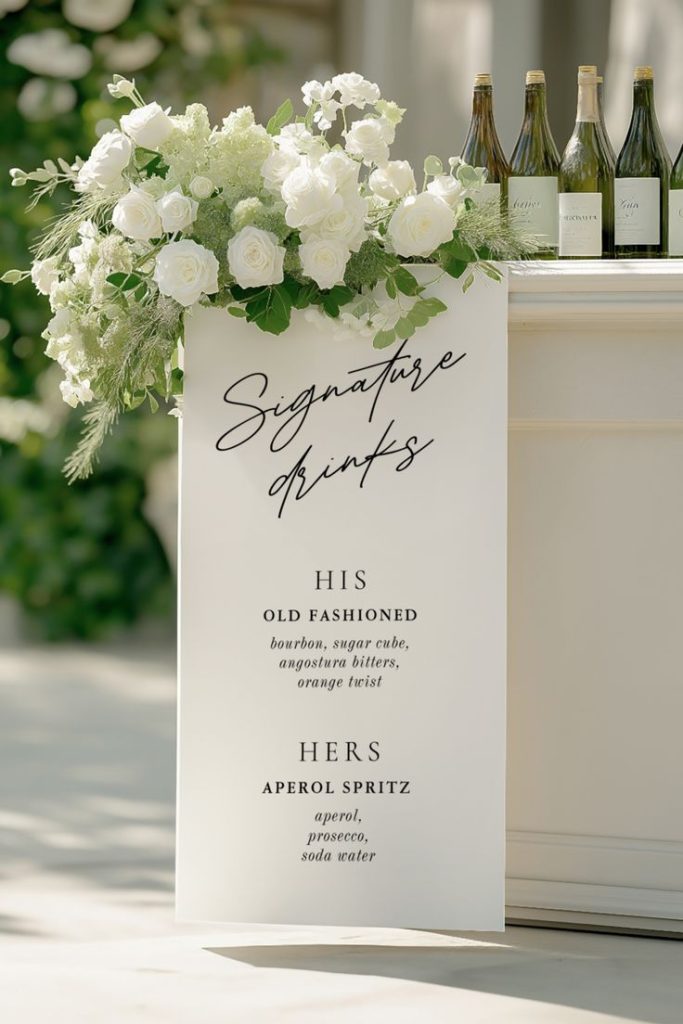
    • His-and-hers cocktails
    • A mocktail option for non-drinkers
    • Drinks named after pets, favourite cities or inside jokes

    Signature cocktails instantly make a wedding feel more intentional and personal. They also photograph beautifully, which certainly doesn’t hurt in the Instagram era.

    The biggest advantage? Budget control

    For many couples, signature cocktails offer the perfect middle ground between elevated and affordable.

    Because the menu is limited, costs become easier to manage. Bartenders can prepare drinks faster, ingredients can be purchased in bulk, and couples avoid paying for dozens of different spirits and mixers.

    This option also works particularly well for:

    • Daytime weddings
    • Intimate celebrations
    • Destination weddings
    • Garden or outdoor receptions
    • Couples prioritising aesthetics and experience over excess

    But will guests feel limited?

    That depends entirely on execution.

    Guests generally don’t mind a limited menu if the drinks feel thoughtful and well-designed. The key is variety. Offering one refreshing option, one stronger cocktail and a non-alcoholic choice usually keeps everyone happy.

    Problems only arise when couples overcomplicate the menu or choose drinks based solely on personal taste without considering guests.

    For example, a highly niche cocktail with unusual ingredients may sound exciting in theory, but not everyone wants smoked rosemary tequila at 2pm.

    The best signature cocktail menus balance personality with crowd appeal.

    So, what works best?

    There’s no universal answer – only what works best for your wedding style, priorities and budget.

    An open bar may suit you if:

    • You’re hosting a large evening reception
    • Guest experience is your top priority
    • Your budget allows flexibility
    • You want a traditional party atmosphere

    Signature cocktails may work better if:

    • You want a more curated, modern experience
    • You’re working within a tighter budget
    • You love personalised details
    • Your wedding aesthetic is experience-focused

    And honestly? Many couples are choosing a hybrid approach.

    A limited open bar paired with one or two signature cocktails often gives guests the best of both worlds. It keeps costs manageable while still creating a memorable, elevated experience.

    The final sip

    At the end of the day, your drinks menu should reflect the kind of celebration you want – not what social media says a wedding “needs.” Guests rarely remember whether the bar carried twelve whiskey options. They do remember how the wedding felt: welcoming, thoughtful and fun.

    Whether that comes through endless espresso martinis or one perfectly crafted signature cocktail is entirely up to you.

    SEE MORE: Creative ways to serve your wedding drinks

    Creative ways to serve your wedding drinks

    Featured image: Pinterest

    Being asked to officiate a wedding is a pretty big deal. Whether it’s your best friend, your cousin or a sibling tying the knot, being chosen to lead one of the most important moments in someone’s life is equal parts exciting, emotional and slightly terrifying.

    Before you panic-Google “how to marry people”, here’s what you need to know. From legal requirements to speech tips, these are the most important tips for officiating a marriage without turning the ceremony into a rambling TED Talk.

    First things first: Can anyone officiate a wedding in South Africa?

    This is where things get a little tricky.

    In South Africa, not just anyone can legally officiate a marriage. To legally marry a couple, you need to be an authorised marriage officer registered with the Department of Home Affairs.

    This usually includes:

    • Religious leaders
    • Certain government officials
    • Designated marriage officers

    So if your friend asks you to officiate their wedding, you technically cannot legally sign the marriage documents unless you’re officially registered and authorised.

    So what do couples usually do?

    A lot of modern couples choose to split the legal and ceremonial parts of the wedding.

    This means:

    • The legal paperwork is done separately through a registered marriage officer or at Department of Home Affairs
    • Then a friend or family member leads the symbolic ceremony on the wedding day itself

    Honestly? Guests usually never even notice the difference. It allows couples to have a more personal, relaxed and meaningful ceremony led by someone who actually knows them.

    Tips for officiating a marriage without freezing up

    Get the vibe right

    Before you write a single word, chat to the couple properly.

    Ask them:

    • Do they want funny, emotional or formal?
    • Are there religious or cultural traditions involved?
    • Do they want guests to laugh, cry or both?
    • Are there any topics or inside jokes to avoid?

    Some couples want a light-hearted ceremony with personality. Others want something more traditional and sentimental. Your job is to set the tone.

    Start with a strong opening

    The first few lines matter more than you think.

    You do not need to sound like a movie narrator or a royal announcer. Keep it warm and natural.

    Tell their story

    One of the best tips for officiating a marriage is remembering that the ceremony is about the couple, not your stand-up comedy debut.

    Share:

    • How they met
    • What makes their relationship special
    • Small moments that show who they are together
    • Why the people around them love them

    Avoid:

    • Embarrassing stories
    • Ex drama
    • Overly private details
    • Anything that could make grandparents uncomfortable

    If you’re using humour, keep it light and inclusive.

    Include personal touches

    This is where a friend or family member officiating can really shine.

    You can include:

    • Personal vows
    • Readings or poems
    • Cultural traditions
    • A moment of silence for loved ones
    • Guest participation
    • A ring warming ceremony

    Practice more than you think you need to

    Even confident public speakers get nervous at weddings.

    Read your script out loud multiple times before the day. Timing, pacing and pronunciation feel very different in your head compared to saying them aloud in front of 100 people and a crying flower girl.

    A few practical tips:

    • Print your speech out
    • Use larger font sizes
    • Speak slower than normal
    • Pause after emotional moments
    • Keep water nearby
    • Don’t wing it completely

    How long should the ceremony speech be?

    Shorter is usually better.

    Most wedding ceremonies sit comfortably between 15 and 30 minutes depending on:

    • Vows
    • Readings
    • Rituals
    • Religious elements

    If you’re leading a non-religious ceremony, aim for meaningful rather than marathon-length.

    Nobody wants to hear you speaking longer than the reception speeches.

    What should you actually say during the ceremony?

    Most ceremonies follow a simple structure:

    1. Welcome guests
    2. Introduce the couple’s story
    3. Share thoughts about marriage or love
    4. Move into vows
    5. Exchange rings
    6. Official declaration
    7. The kiss
    8. Final introduction of the married couple

    You don’t need fancy language. You just need sincerity.

    ALSO SEE: Nail your wedding speech

    Nail your wedding speech

    Feature image: Pexels

    The wedding exit photo is an important one! It symbolises you, as a newly-wed couple, taking your first steps out into the world as a unit. Many couples go all out for wedding exists, from leaving in a tractor to escaping in a helicopter.

    If you want to keep it simple but still make it special there are tons of options too! There’s no need to stress about an over-the-top exist that, in the end, burns an unnecessary hole in your pocket.

    Here are some simple but stunning ideas to inspire you:

    Classic: 

    (Many people are now against confetti and instead use biodegradable versions like this couple who are using “Floralfetti”)

    Sparklers: 

    Bubbles: 

    Through your bridal party:

    Ribbons: 

    Light Sabers: 

    Pom-poms: 


    View this post on Instagram


    A post shared by Blackberry Ridge (@blackberryridgega)

    Glow sticks: 

    Sports references:

    Flower petals: 


    View this post on Instagram


    A post shared by MELISSA GLYNN (@mglynnphoto)

    ALSO SEE: What is an Irish exit?

    What is an Irish exit?

    Feature image: Pexels

    Mr and Mrs seem like given titles for those that choose to walk down the aisle and say ‘I do’. Have you ever wondered where these titles come from? The origin might surprise you.

    The titles originally had nothing to do with marital status. Cambridge University historian Dr. Amy Erickson explains that ‘Mrs’ and ‘Miss’ derived from the word ‘mistress’ while  ‘Mr’ comes from ‘master’.

    “Few people realise that ‘Mistress’ is the root word of both of the abbreviations ‘Mrs,’ and ‘Miss,’ just as Mr is an abbreviation of ‘Master.’ The ways that words derived from Mistress have developed their own meanings is quite fascinating and shifts in these meanings can tell us a lot about the changing status of women in society, at home and in the workplace,” she said

    According to author Samuel Johnson, a mistress could be defined as “1. A woman who governs; correlative to subject or servant; 2. A woman skilled in anything; 3. A woman teacher; 4. A woman beloved and courted; 5. A term of contemptuous address; 6. A whore or concubine.”

    Back in the mid-18th century, ‘mistress’ didn’t have quite the negative connotations it has today. In those days, a mistress typically referred to a woman of high economic or social capital, rather than a married woman. A woman referred to as Mrs in the 18th century was thus not necessarily married.

    Those on the lower scales of society were simply referred to by their names. For example, the lady of the house might have been Mrs Abernathy, while the scullery maid would simply be Anna Black.

    Mr and Mrs were on equal standing, and Erickson argues those that held these titles were more like businessmen and women as they governed servants or apprentices, and were quite literally the masters and mistresses of their trades.

    It was only in the late 18th century that the use of Mrs became attached to marital status. The title Miss, which was originally a title for young girls, started to be used as a term to refer to an unmarried woman of a high social status, who was often a teacher. These young, socially ambitious single women wanted their own title that would mark their social class but not lump them into a group with the older businesswomen and heads of households that typically held the title of Mrs.

    This new term thus shifted the meaning of Mrs to signify a married woman and create a distinction between young and older.

    Why the pronunciation of mistress turned to ‘missus’ is unclear. In A Critical Pronouncing Dictionary, and Expositor of the English Language from 1828, author John Walker suggests its a result of colloquialism.

    “The same haste and necessity of dispatch, which has corrupted Master into Mister, has, when a title of civility only, contracted Mistress into Missis,” he wrote.

    ALSO SEE: Relaxing bachelorette party ideas for the chilled bride

    Relaxing bachelorette party ideas for the chilled bride

    Feature image: Unsplash

    South African entertainment is celebrating a real-life love story after House of Zwide co-stars Shalate Sekhabi and Wanda Zuma reportedly tied the knot, taking their on-screen romance to the next level.

    The pair won over audiences with their portrayal of Shoki and Nkosi on the hit telenovela House of Zwide. Their undeniable chemistry quickly made them fan favourites, with viewers deeply invested in their relationship storyline.

    Off-screen, that connection grew into something more. After keeping their relationship relatively private, the couple confirmed their romance and later their engagement—much to the excitement of fans who had long speculated about their bond.

    According to reports, Shalate and Wanda recently celebrated their union in a traditional wedding ceremony attended by close friends and family. While the couple has not publicly shared full details, snippets circulating on social media reveal a stylish and culturally rich celebration.

    From elegant traditional attire to intimate moments captured by guests, the wedding has quickly become one of the most talked-about events in South African entertainment this week. Both Shalate and Wanda  have built strong fan bases through their work on House of Zwide, and their real-life relationship has only strengthened their popularity.

    For many fans, their journey feels like a fairytale—proof that sometimes, on-screen love can turn into something genuine beyond the cameras.

    Mzansi has taken to social media to celebrate the couple, with congratulatory messages pouring in. Fans have described their union as “beautiful,” “unexpected,” and “straight out of a script.”

    The story has also sparked conversations about love in the entertainment industry, with many praising the couple for keeping their relationship grounded despite being in the public eye.

    @andile_hlungwane

    #shalate #wandazuma #southafricatiktok🇿🇦 #celebritycouple #amora

    ♬ original sound – Pertunia

    One user said: “So their love in acting was real, congrats though.”

    Another one said: “Congratulations to Wanda and Shalate.”

    While another one said: “Another example that shows us that people can really get feelings for each other on set.”

    While the newlyweds have yet to release an official statement, anticipation continues to build as fans eagerly await more glimpses into their big day. With their love story now sealed in real life, all eyes will be on what’s next for the couple.

    ALSO SEE: Sue Duminy shares her engagement news

    Sue Duminy shares her engagement news

    Written by Zintle Mdaka for BONA.

    Feature image: Wanda Zuma/Facebook

    South African actor Neels van Jaarsveld appears to have married his partner, Gerna Peterson, if a recent Instagram post is anything to go by.


    As the backdrop to your wedding, your wedding arch quite literally frames your ceremony. Flowers, fabrics and unusual shapes bring your wedding arch a unique, personal touch guaranteed to wow your guests.

    Here are some ideas for your big day:


    View this post on Instagram


    A post shared by L (@seniorfloraldesign_supplier)


    View this post on Instagram


    A post shared by Heike Hayward (@fleurlecordeur)


    View this post on Instagram


    A post shared by BISOUS EVENTS (@bisous_events)


    View this post on Instagram


    A post shared by Ilsé Vincent (@blomstories)


    View this post on Instagram


    A post shared by Heike Hayward (@fleurlecordeur)


    View this post on Instagram


    A post shared by Ilsé Vincent (@blomstories)


    View this post on Instagram


    A post shared by Heike Hayward (@fleurlecordeur)


    View this post on Instagram


    A post shared by Ilsé Vincent (@blomstories)


    View this post on Instagram


    A post shared by Heike Hayward (@fleurlecordeur)

    ALSO SEE: Tips for choosing your wedding’s signature cocktail names 

    Tips for choosing your wedding’s signature cocktail names

    Feature image: Jonathan Borba/Unsplash

    One of the wedding traditions that have stood the test of time in some relationships is the preservation of the top tier of a wedding cake. Couples save the top tier of their wedding cakes and eat it on their one-year anniversary. It may sound impractical, but we’re here to show you how to do it!

    Before we get to the tips for preserving your wedding cake, perhaps a little background on the tradition is necessary. These days, saving your cake for a year is understood as an omen for good luck. But where does the tradition come from?

    The story of cake preservation has two short parts. The first is that having a child in the first year of marriage was much more common in years gone by. For this reason, a couple would prefer to save a part of the wedding cake for the celebration of the birth of their child instead of getting a new cake.

    The second part of its story goes back to the 19th century and follows the actions of Queen Elizabeth II (or Princess Elizabeth at the time). When the Princess married Prince Philip in 1947, they had a three-tier cake. Each tier had a designated purpose – the bottom tier was to be cut at the wedding, the middle was to be sent off as a gift, and the top tier was to be saved for a future occasion. The future occasion here was the presumed upcoming birth of a child.

    Now, instead of saving it for the birth of the first child, the couple saves it for the first anniversary which is usually much closer in time to the wedding. The tradition seems to have stuck as a symbol of bringing the past into the present and of celebration.

    So, how do you preserve your top tier? Here are a few tips:

    – Decide on preserving it in advance 

    To ensure that the top tier doesn’t get cut on your wedding day, let your caterer know that you’ll be preserving it well before the ceremony. Deciding on preserving the cake early also helps you decide on fillings which may be longer lasting than others or decorations and designs that are able to withstand a year in the freezer.

    – Remove ornaments and flowers (real or sugar) 

    When you wrap the cake, it needs to be airtight.  The extra decorations will prevent the cake from being wrapped airtight.

    – Chill the cake 

    As soon as you get a chance, pop the cake in the freezer. This allows the cake to harden and preserve the icing properly. Ensure that there are no soft bits around the cake before you take it out of the freezer.

    – Double wrap it 

    First, wrap the cake with plastic. Push the plastic onto the cake so that there are no air bubbles. Then cover it again with foil. This ensures that nothing can get in. It also helps to ensure that other things in the freezer don’t pass their smells or tastes onto your cake.

    – Freeze

    Once the cake is tightly wrapped, label it (to ensure it doesn’t get mistaken for something else) and pop it in the freezer!

    – Eat later 

    Once your first anniversary comes, you’ll defrost the cake. Take the cake out of the freezer the day before your anniversary and keep in the fridge overnight. Then take it out of the fridge and leave it at room temperature for about 5 hours. Thereafter, it’ll be ready to eat!

    Many couples want to participate in this tradition but, for whatever reason, prefer not to save the cake. If you don’t see yourself saving the cake, but still want the sentiment and symbolism that comes with this tradition on your first anniversary, chat to your caterer and let her know that in a year you’ll be ordering an identical top tier. You may end up receiving a special deal or a totally free top tier!

    ALSO SEE: Your guide to the perfect wedding seating plan

    Your guide to the perfect wedding seating plan

    Image: Pexels

    Technology is undoubtedly a massive part of our lives in this day and age. Our phones are practically extensions of our arms and we can’t go without checking in to our social media once a day. Most of our memories are made by captured moments on our digital devices and not by living in those moments. This can frustrate people who would rather be doing the latter, especially when it comes to significant occasions such as weddings.