• Category

    Rings

    Category

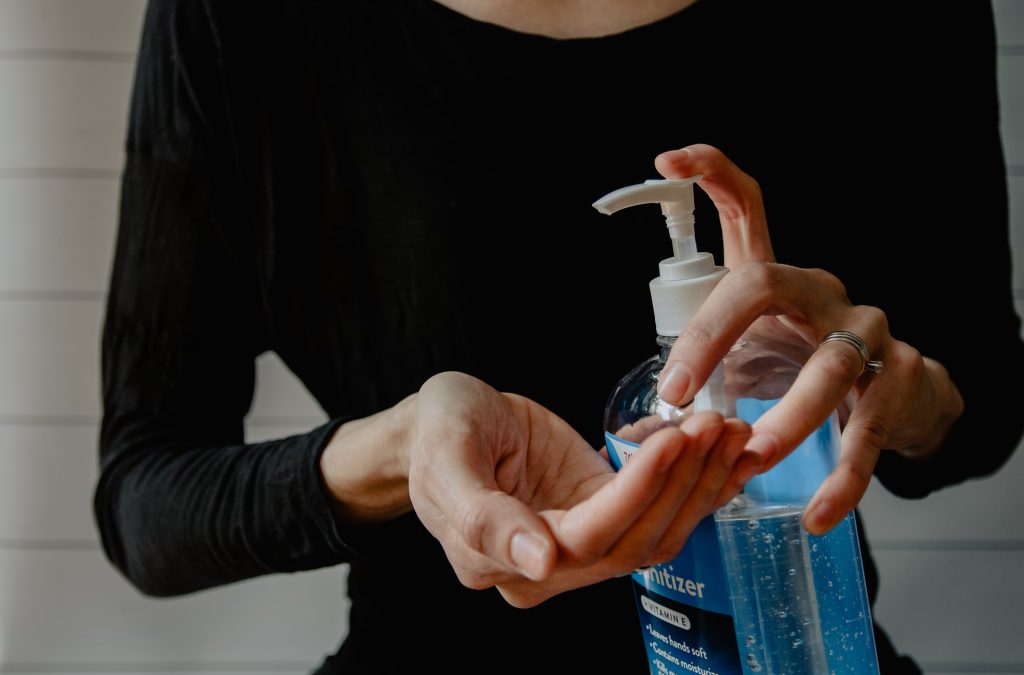
    With the spread of the coronavirus in South Africa and across the world, people are much more conscious about hygiene. Specifically hand hygiene. All we’ve heard from our leaders is for weeks is “wash your hands, don’t touch your face”. This has led to an increase in the use of hand sanitizer.

    The hand sanitizer you should be using consists of about 70% alcohol (isopropyl or ethyl) mixed with water, glycerine and fragrance.

    You’d think that no harm can come from using proper hand sanitizer. After all, you’re trying to protect yourself from a pandemic. While you’re taking care of yourself, however, be sure to take care of your engagement ring too!

    It turns out that hand sanitizer is quite bad for your ring, especially when it’s used excessively (much like we’re all doing these days). According to James Allen, an online diamond and bridal jewellery retailer, contact with cleaners that contain chlorine, bleach, and rubbing alcohol “can break down the brilliance of metals and gems over time”. The last thing you want is for your ring to lose it’s sparkle!

    Experts at James Allen also warned of a different way the sanitizer could be ruining your ring. “Extensive hand sanitizer use can also loosen prongs that hold diamonds in place,” they said. This means you’re putting your diamond at risk. It could loosen and fall out without you noticing.

    Of course, we don’t want these risks to stop you from practicing good hygiene. Quite the opposite, actually.

    All you need to do is remove the ring from your finger each time you sanitize and you should be good to go! Remember to wait until your hand dry’s before placing the ring back on your finger.

    If you really want to protect your ring, you could choose to remove it until the coronavirus pandemic passes. Bacteria can make its way into the grooves of your ring. If you don’t plan on cleaning the ring, it may be better to store it away until this all blows over.

    It’s not that difficult to clean your ring though! So, if you want to keep wearing it, simply pop it in some warm water with dish washing soap at least once a week! Voila, good hygiene and a ring that remains safe and sound.

    Image: Unsplash
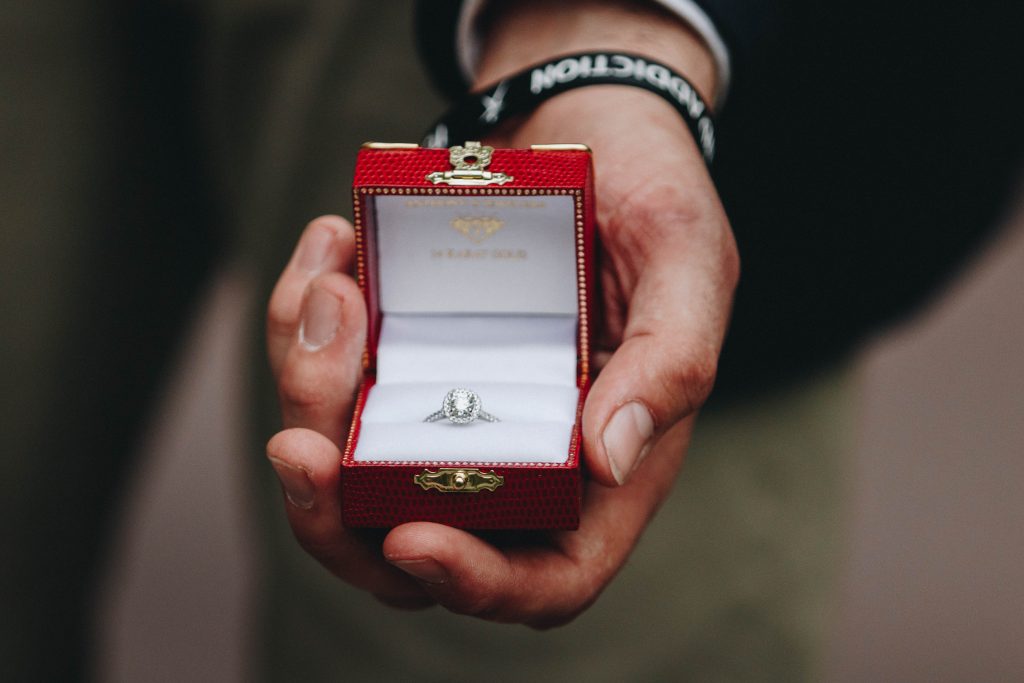
     

    Choosing an engagement ring is tricky. Not only do you have to consider the cut, colour, carat, and setting style, but have to remember that each choice needs to match the previous one.

    On top of this the ring receiver (in most cases the bride) has to like it. After all, she’s the one who’ll be wearing it for the rest of her life.

    For this reason, people may consider having the bride choose her own ring. Now don’t get too upset at the idea! It doesn’t have to be a controversial move. I mean, we’re in the age of independence right? Women are making their own choices and this is just another one they would probably love to make for themselves.

    If you’re not sold on the idea of the bride choosing her own ring. Here are some pros and cons, to help you make your final decision.

    Pros 

    – You get to spend quality time together 

    It can be a lovely bonding experience for the two of you. Instead of it being a stressful time in store for one partner alone, it can be a way for you two to get to know each other even more.

    – No guessing games 

    As mentioned before, there are a lot of decisions to make with rings. It’s also impossible to know what cut, colour, and setting style your bride will want without specifically asking her. So, instead of playing a guessing game while you consult the jeweller, have your partner by your side to make the decisions herself!

    – Sets the tone for wedding planning 

    It’ll be the first wedding task you do together and will give you some insight into what the wedding planning will be like.

    Cons 

    – Takes away the surprise factor

    While you can still keep the date and proposal plans a surprise, your bride will know she’s getting proposed to sooner or later. That might take the fun out of it for many people.

    – Waiting after buying

    The bride will spend every second after choosing the ring in anticipation of the proposal coming her way. If she has to wait too long she might get frustrated, but you also don’t want to rush it. This could complicate things.

    – Money-talk could get awkward 

    The bride will know the budget for the ring. Most couples are good with being open about these things, but if you aren’t then taking your bride ring shopping is probably not a good idea.

    Image: Unsplash

    If you’re in the market for an engagement ring, you need to remember to keep the setting options in mind. It may seem trivial, but it makes a huge difference to the look and style of the ring.

    Each setting has a different way of securing the diamond. Here is a cheat sheet to some of the most popular setting styles:

    Halo 

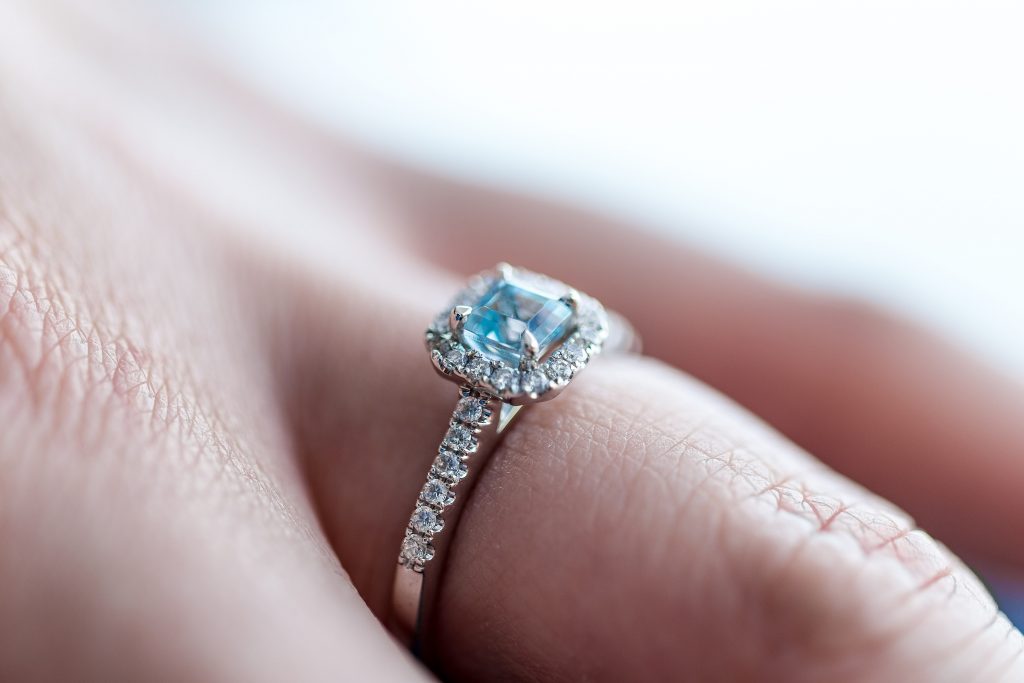
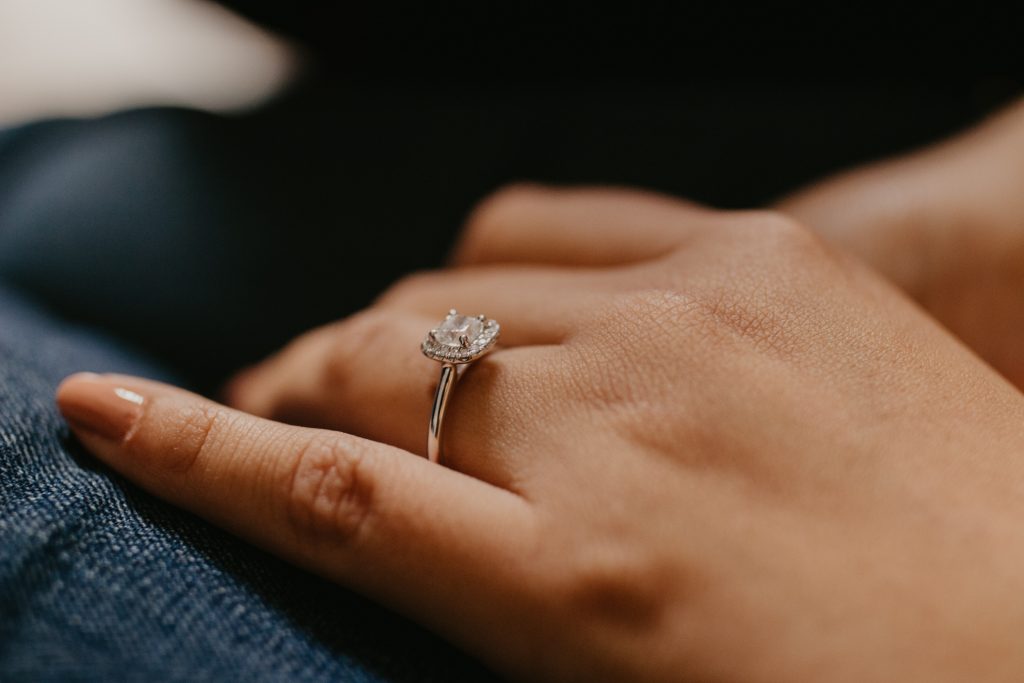
    Additional diamonds are ordered in a circle or square around the main stone. This makes the centre gem look larger and increases the sparkle of the ring overall.

    https://www.instagram.com/p/B7EWEkInayP/

    Prong 

    This is the most common and classic setting. It features a metal claw, which grips the diamond. The setting can be round, pointed, v-shaped or flat. The setting does well to elevate the stone, bringing it to the attention of anybody looking towards your hand.

    https://www.instagram.com/p/B56-3eOHvk-/

    Tiffany 

    Of course, you can’t talk about rings without a mention of Tiffany. The Tiffany setting features six prongs, and is distinguished from the prong setting by the knife-like edge of its shaft and the design of its prongs.

    https://www.instagram.com/p/BuDxRyrn9L9/

    Cathedral 

    Taking inspiration from what it’s named after, this setting uses arches that resemble those of a cathedral to hold the diamond in place. It’s defining characteristic is how the diamond is mounted with the arches on top of the rest of the shank.

    https://www.instagram.com/p/B3myeCYHxbx/

    Channel 

    The channel setting secures other diamonds in the band, creating a row of sparkling gems that leads to the main stone. The one is great for those who love a little extra sparkle.

    https://www.instagram.com/p/B9fJbDhlvkU/

    Bezel

    With its modern appearance, this one is quite popular too. The Bezel setting holds the diamond by encircling it with a metal rim. This setting holds the stone tightly in place and therefore is great for anybody who lives an active lifestyle.

    https://www.instagram.com/p/B6hLZYiFYgR/

    Tension 

    Named aptly, the tension setting holds your gem in place with tension of the metal band. The diamond seems to be suspended between the two edges of the band.

    https://www.instagram.com/p/B7b9dIdAEkd/

    Image: Unsplash

    Buying a diamond is a huge decision. It can get very expensive and for that reason you want it to last a lifetime. It’s best, then, to ensure you’re buying a real diamond before you make the purchase.

    If you’ve already bought it, and are having some doubts about its authenticity, worry not because there are some way you can determine this.

    Don’t get caught out by diamond replacements such as cubic zirconia or moissanite, and ensure you don’t have a fake on your hands using these tests:

    – The water test

    A diamond has high density, so it shouldn’t float in water. All you need to do is fill a glass with water and drop the diamond in. If it floats, it’s fake.

    – The fire test

    Use a lighter to heat the gem for no less than 30 seconds, then drop it into ice-cold water. If the stone remains unharmed then it’s real and if not then it’s fake. Weaker materials cannot handle the rate of expansion and contraction that’s provided through this test. A diamond, however, will withstand it.

    – The fog test

    This one is quick and easy. Hold the diamond close to your mouth and try to fog it up. If it stays fogged for more than 4 seconds, it’s likely that it’s fake. This is because diamonds disperse heat easily, which means it’s quite difficult to fog up.

    For this test to work, your stone has to be completely clean with no oils covering it.

    – Black light test 

    Of course you’ll need a black light for this test. Turn off the lights, shut the curtains and hold the stone in front of the black light. Most diamonds will reveal blue fluorescence. If you see slight green, yellow, or grey, your diamond is fake. It’s important to remember that for this test, that not all diamonds will reveal blue fluorescence.

    – Imperfections test 

    Look at your gem through a magnifying glass. If you don’t find imperfections, you have a fake on your hands. A real diamond will have imperfections, referred to as inclusions.

    – The dot test

    Draw a small dot on a white piece of paper and put the stone onto the dot, with the flat side down. Looking through the pointed side of the diamond, try to see the dot. If you see a circular reflection, the diamond is fake.

    Diamonds have strong refractive qualities. Therefore, light bounces around in all directions instead of in a straight line. Because of this, you won’t be able to see the dot through a real diamond.

    It’s important to remember that these tests are not 100% conclusive. If you’re still unsure by the end of these tests, then the best option is to head over to a diamond expert who will have the necessary equipment to investigate.

    Image: Unsplash 

    Once you receive your precious engagement ring, it’s understandable that you’d never want to take it off. The ring shows your partners love, affection, and commitment to you, which makes it extremely special. For this reason, it needs to be protected!

    The best way to protect your engagement ring is to know when you shouldn’t wear it. This way you won’t lose or damage it.

    Here’s when to remove the bling:

    – When you’re doing housework

    While you’re cleaning you may knock the ring. This is more common an occurrence than you’d expect. To ensure that your ring remains unscratched and unharmed, remove it before you start cleaning.

    Additionally, cleaning products like bleach and ammonia damages both the metal and the stone of your ring.

    – In the shower 

    The scrubbing and soaking you do in the shower will take a toll on your band. It may even end up scratched.

    – Working out

    First off, the ring may fall off and you’ll lose it.  That’s the last thing you’d want. Second, the ring could get damaged by weights you use – the pressure on the ring could bend the band and result in the stone falling out of its setting.

    – During your beauty routine 

    Soaps, creams, perfumes and other such products all result in damage to your ring. If you keep your ring on every time you apply these products, it will build up and collect. This will result in a build up of grease and over time will result in deterioration.  If the products get under the stone, it way loosen it from its setting too.

    – Travelling 

    Travelling is tiring and keeps you busy, you could get lost in the activities and end up losing your ring.

    – Cooking 

    This is a recipe for disaster. The oils, fats, and flours will result in long term damage to your engagement ring. In fact, cooking is one of the biggest reasons people’s rings get ruined! So ensure that you take it off when preparing that romantic meal.

    Image: Unsplash 

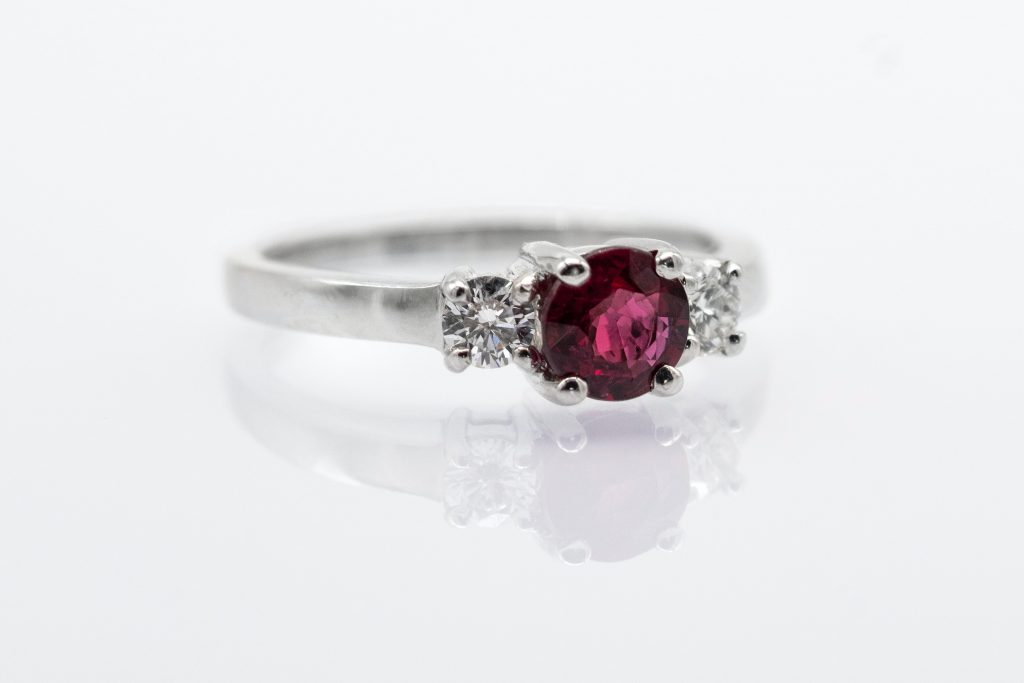
    Red is often considered the colour of love, so what’s more romantic than a ruby? This red-hued stone has been a favourite of royalty for centuries, earning the moniker ‘king of gems’.

    Rubies make up one of the four main precious gemstones, joining emerald, sapphire and diamond. The word comes from the Latin “rubens”, meaning red. The stone is made up of corundum, a crystalline form of aluminium oxide containing traces of iron, titanium, vanadium and chromium. Technically, rubies and sapphires are the same stone as they are made up of the same chemical properties. However, a stone of this makeup in any colour besides red is considered a sapphire. The mineral chromium is what gives the stone its characteristic red tinge, differentiating it into a ruby.

    Given its deep red colouring, rubies are often associated with love and desire. The stone can range in shades from pink to oxblood. The most desirable shade is called ‘pigeon-blood’, a deep red with a hint of blue.

    https://www.instagram.com/p/BnSdOF-Aksf/?utm_source=ig_web_copy_link

    Rubies are found all over the world, from Myanmar (previously Burma), Africa, Australia to the USA. This precious gemstone has long been highly revered by Asian cultures. The first ruby was discovered in Myanmar back in 600AD and were worn as talismans by Burmese soldiers in battle as a form of protection. In Sankrit, rubies are called ratnaraj, or “king of precious stones”.

    Popularity soon spread to Europe and rubies became one of the most sought-after gems for European royalty and the upper class after it was selected as the stone of choice for British coronation rings back in the 13th century. The stone was said to guarantee health, wealth, wisdom and success in love.

    https://www.instagram.com/p/B8zGXzZH-_W/?utm_source=ig_web_copy_link

    As with other gemstones, rubies are graded on the four C’s: colour, cut, clarity and carat weight. The world’s most valuable ruby is the Sunrise Ruby, a 25.59-carat (5.1 g) “pigeon blood” ruby discovered in Myanmar. The stone was mounted by Cartier and set between heptagonal diamonds weighing 2.47 carats (0.49 g) and 2.70 carats. It sold for a record $30.42 million on May 12, 2015 at a Sotheby’s auction in Geneva, Switzerland to an anonymous buyer.

    https://www.instagram.com/p/B0YZp3Glror/?utm_source=ig_web_copy_link

    Feature image: Unsplash

    For those humanitarians and environmentalists out there, engagement ring shopping can be a struggle. Due to the carbon footprint – among other things – caused by diamond mining, younger people are attempting to take a step away from the traditional engagement ring. This has led to a fast growing trend – lab-grown diamond rings.

    According to BBC Future, almost 70% of millennials have considered this guilt-free engagement ring alternative. An added bonus to lab-grown diamonds for your engagement ring is that they are much more affordable, meaning you won’t break the bank.

    So what exactly is a lab-grown diamond?

    Essentially, they are man-made diamonds. What’s interesting, however, is that while they are created in laboratories, they are chemically and physically identical to natural diamonds, and are just as hard.

    There are two main methods used to grow these diamonds: The CVD (chemical vapor deposition) method and The HPHT (high pressure high temperature) method. Lightbox, a company who lab-grows diamonds describes these methods:

    CVD – “Lab grown diamond seeds are loaded into a CVD reactor. Then, a mix of gasses containing carbon is added at a very low pressure. Microwaves are added to heat the gases and generate a plasma. When the temperatures climb over several thousand degrees, the gas molecules break apart and carbon atoms bond to the seeds, growing them one layer at a time,” says Lightbox.

    HPHT – “This method mimics the conditions under which diamonds naturally form. Large mechanical presses are used to apply extreme pressure and high temperature to carbon in the presence of a diamond seed. The seeds act as a template for a lattice of carbon to grow layer by layer over the course of a few days,” they said.

    Because of their man-made nature, they only take a few weeks to make whereas a real diamond takes billions of years to grow.

    So if you’re looking to live a more eco-friendly, sustainable and conscious life then lab-grown diamonds are the way to go!

    Here are some lab-grown diamond engagement rings to inspire you:

    https://www.instagram.com/p/Bvxi-HzlGKH/

    https://www.instagram.com/p/BiwA1PGhFJO/

    https://www.instagram.com/p/B6wwQL9hKt0/

    https://www.instagram.com/p/B7x42eRF1K0/

    https://www.instagram.com/p/B9F6woGBMzO/

    Image: Unsplash 

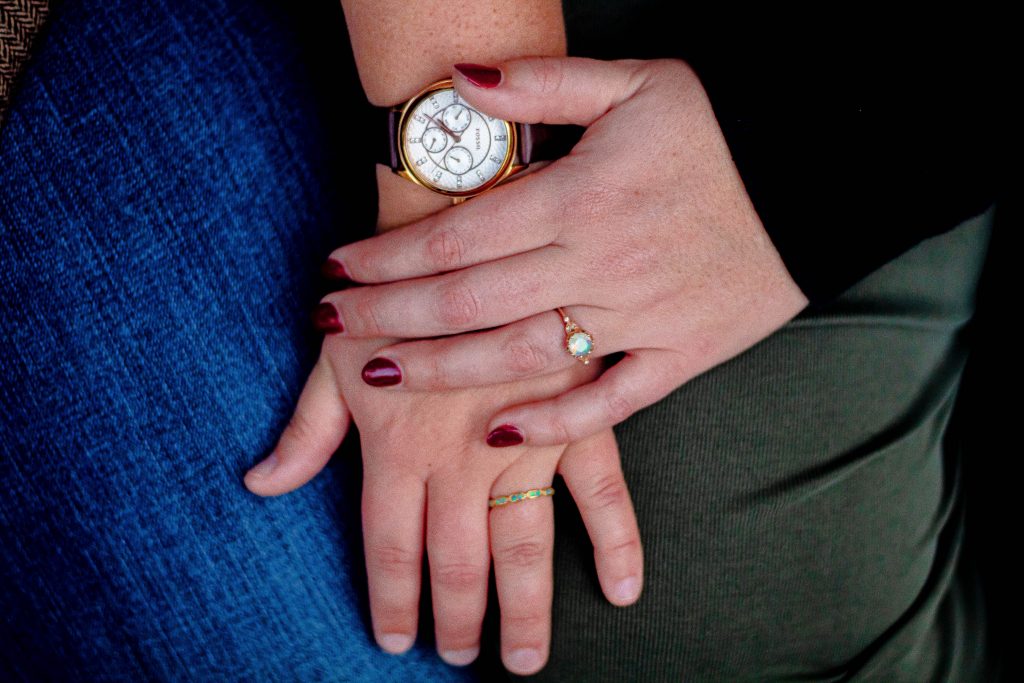
    Those wanting a unique engagement ring, look no further. An opal may be an unconventional choice to centre your engagement ring, but wow is it stunning. This unique gemstone is much loved by many for its mesmerising pattern and kaleidoscope colours.

    Birthstone for the month of October, opals can be dated back to 4000 B.C. The gemstone is made up of a solution of silicon dioxide and water. As water runs down the Earth, it collects particles of silica from sandstone. This mixture falls into cracks and voids and as the water evaporates, it leaves behind a silica deposit that will eventually turn into an opal. This, however, is an incredibly slow process, and takes an estimated 5 million years to solidify just one centimetre of opal.

    The name is said to be derived from the Roman word ‘Opalus’ which translates into ‘precious stone’, and the Greek derivative ‘Opallios’, meaning ‘to see a change of colour’. The ancient Greeks believed that the gemstone was formed by tears wept by Zeus, God of the sky and thunder, when he defeated the titans. As such, the gemstone was believed to have prophetic powers. The stone is symbolic of purity and hope, protecting the wearer from harm.

    https://www.instagram.com/p/B8hJD1jBXFa/?utm_source=ig_web_copy_link

    Opals can be sorted into two classes: precious and common. Precious opals are iridescent, common opals are not. Precious opals traditionally display two colours: the background colour and their play-of-colour (iridescence). The impurities within the silica determine the stones background colour, and the play-in-colour is created by the way the silica settles together. Those colourful flecks you see in the stone are made up of tiny silica-spheres that reflect light. As a result, opals can come in most colours from red to blue and even black – the rarest form.

    There are a multitude of natural opals, such as black opal, white opal, crystal opal and jelly opal. Boulder opals are the most unique and are able to reflect the entire rainbow.

    The majority of the world’s opals come from Australia, although other popular countries include Ethiopia, Brazil, and Mexico. Wildly enough, opals have even been discovered on Mars!

    https://www.instagram.com/p/B8eZrTqF0hE/?utm_source=ig_web_copy_link

    The opal market was almost destroyed by author Sir Walter Scott’s 1829 bestselling novel, Anne of Geuerstein, which told the story of a woman accused of being a demoness who died when holy water touched her opal and destroyed it. Opal sales plummeted after the book was published as readers believed the book was warning of the opals bad luck. In 1877 a black opal was discovered in New South Wales, Australia, helping this precious gemstone lose its bad reputation.

    https://www.instagram.com/p/B8bS-DZFHlR/?utm_source=ig_web_copy_link

    Since then, opals have continued to be popular among many. It was Queen Victoria’s favourite stone, and was even dubbed ‘the Queen of Gems’. Other royal icons that shared a love for this precious stone include Cleopatra and Empress Josephine. Millennial brides are loving this one-of-a-kind gemstone for its vintage feel and unique look.

    Feature image: Unsplash

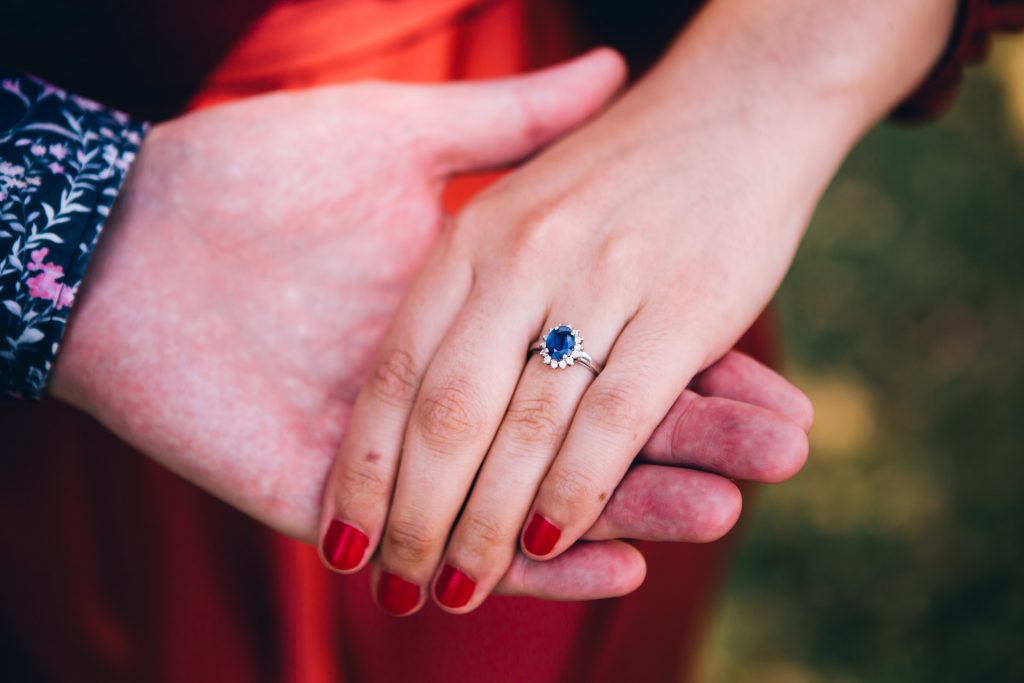
    Deep blue is the colour of royalty, so it is no surprise a rich sapphire stone would centre Kate Middleton’s engagement ring. Once belonging to Princess Diana, this iconic ring caused sapphire sales to skyrocket in 2010 following the royal engagement announcement. Even before this proposal, however, sapphires have been adored and coveted for their intense colouring.

    The name of this precious gemstone comes from the Greek word ‘sappheiros’ and the Latin word ‘saphirus’, both of which translate to mean blue. Despite the name, however, sapphires come in a range of colours from blue to yellow to pink. The only colour is cannot present as is red as it would then be considered a ruby. Naturally, blue is the most coveted colour variant.

    https://www.instagram.com/p/B7MLygjDmfD/?utm_source=ig_web_copy_link

    Sapphire is one of the four main precious gemstones, including diamonds, rubies and emeralds. While found all over the world, the highest-quality and most prestigious sapphires come from Kashmir, Myanmar, Thailand, Cambodia, Australia, Sri Lanka, Madagascar, and Montana.

    The stone is believed to have healing properties, and is regarded as the stone of mental focus and order, inner vision and psychic awareness. Chakra theory also believes that sapphires help open one’s third eye, thus allowing wisdom and insight to enter.

    This stone is much loved by celebrities such as Princess Diana, Penelope Cruz and Elizabeth Taylor.

    https://www.instagram.com/p/B8d4KiahwI_/?utm_source=ig_web_copy_link

    Coloured stones have been trending in the engagement world for the past few years, and sapphire makes an excellent choice because it can double up as your ‘something blue’. When picking one out, always refer to the four Cs: colour, cut, clarity and carat.

    Feature image: Pexels

    In today’s times, you have to be creative with your proposal. This guy decided to go over-the-top, literally, with his proposal and sent an engagement ring to space.

    Capt. Stuart Shippee of the 393rd Bomb Squadron at Whiteman Air Force Base, Missouri, popped the big question to his girlfriend Marie Lisman in a very creative way by launching a weather balloon into space with a decoy engagement ring attached to it. Lisman thought they were sending a military challenge coin up with the balloon, but Shippee swopped it for a ring at the last moment.

    The ring travelled a far distance, reaching a height of over 90 000 feet, about three times the cruising altitude of a 747, before bursting and plummeting back to Earth. The balloon landed in a nearby cornfield and once the group found the ring, Shippee went down on one knee with the real ring. Of course, Lisman said yes!

    “When I first picked up the balloon payload, I did not see the imitation ring until I looked down and [Shippee] was on his knee,” Lisman told Military.com. “I was speechless! After the long day and difficult search for the payload I was very happy to have the ending be so special.”

    Watch the video of this amazing proposal below:

    Feature image: Youtube