A wedding is often described as the joining of two people, but for couples entering marriage with children, the reality can be much bigger than that.
There may be children from previous relationships, stepchildren, co-parents, former spouses, different family traditions and, sometimes, complicated feelings about what this new chapter means. A blended family wedding is therefore not simply about finding the perfect venue or choosing the right processional. It is also an opportunity to acknowledge the people who are already part of your lives and thoughtfully create space for the family you are building.
And while it may be tempting to treat the wedding as the moment when everyone suddenly becomes one happy family, experts caution that blending families is a process rather than a single event. Children may need time to adjust to new relationships, household structures and changing family dynamics.
The wedding can mark the beginning of that journey, but it does not need to solve everything in one day.
Start with the conversations that matter
Before choosing ceremony readings or deciding who walks down the aisle, talk about what the wedding means to everyone involved. For the couple, that might mean discussing which family traditions are important, how children will participate and what boundaries need to be respected with former partners or co-parents.
For children, the conversation may look different depending on their age. Some may be excited about having a role in the ceremony, while others may feel uncomfortable with the attention or uncertain about what their parent’s marriage means for them.
The key is to give them a voice without making them responsible for the adults’ emotions. Instead of saying, “You’re going to be our ring bearer,” ask, “Would you like to be involved, and what would feel special to you?” – That small distinction matters.
Let children participate in a way that feels natural
There is no rule saying every child has to walk down the aisle, deliver a reading or stand beside the couple during the vows. For some children, being part of the ceremony will feel incredibly meaningful. For others, a private moment with their parent before the ceremony may mean much more.
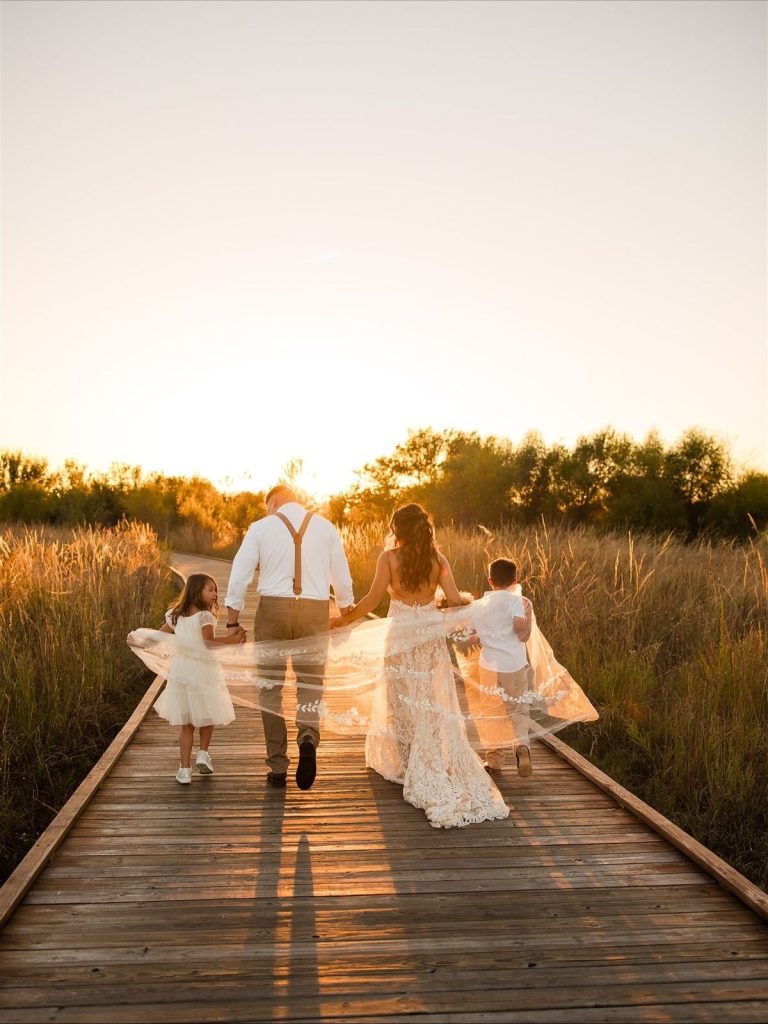
Children can be involved in ways that suit their age and personality. They might walk down the aisle, carry the rings, take part in a unity ritual, give a reading, help with the reception or simply share a special family photograph with the couple.
A recent approach to children’s involvement in weddings has increasingly focused on belonging rather than performance. The goal is not to give a child a job simply because the wedding programme needs one. It is to create a meaningful opportunity for them to feel seen and included. And importantly, give children an out. If a child changes their mind about participating, that should not become a source of guilt or embarrassment.
Consider vows that recognise the whole family
Traditional wedding vows naturally focus on the couple, but blended families offer an opportunity to acknowledge the wider commitment being made.
Some couples choose to include their children in their vows, making promises about the kind of stepparent they hope to be or acknowledging the family they are creating together. Others choose a separate family blessing or ceremony ritual. There is no need to make the moment overly formal. A simple promise of patience, respect, support and love can be incredibly powerful.
The important thing is to avoid suggesting that the new marriage replaces an existing parent-child relationship. A stepparent is joining an existing family story, not erasing the chapters that came before it. Research exploring stepfamily formation has also highlighted the importance of allowing relationships between stepparents and children to develop over time rather than expecting instant closeness. Your wedding can celebrate the beginning of that relationship without pretending it is already fully formed.
Bring traditions together without forcing them to match
One of the most beautiful parts of a blended family wedding can be finding ways to honour different histories. Perhaps one family has a cultural ceremony that is deeply meaningful, while the other has a particular reception tradition they cannot imagine the wedding without. Maybe there are religious customs, family recipes, music, heirlooms or rituals that deserve a place in the celebration.
You do not necessarily have to choose one over the other. Rather than trying to make every element perfectly symmetrical, look for opportunities to create something new that belongs to both families. A unity ceremony involving the children can be one option. Sand, candles, handprints or another symbolic ritual can allow everyone to contribute to a moment that represents the family coming together.
The result does not have to look like a traditional wedding ritual. In fact, that is often the point. Your family does not have to fit an existing template.
Be thoughtful about co-parents and former partners
This is often one of the more delicate parts of planning a blended family wedding. If children have an active relationship with another parent, their presence and feelings need to be considered. That does not mean every former spouse needs to be invited, included in the ceremony or given a formal role. It simply means the couple should think carefully about how the situation could affect the children.
Clear boundaries and respectful communication are important, particularly when children are moving between households or adjusting to new family arrangements. The American Psychological Association notes that blended families can face particular challenges around parenting, roles, finances and relationships, making communication and clearly established expectations especially important.
If a former partner will be attending, discuss practical details beforehand. Where will they sit? Who will they interact with? Are there sensitive moments that need to be handled privately? – And perhaps most importantly, keep adult conflict away from the children. The wedding should not become the stage for unresolved relationship issues.
Give everyone room for complicated feelings
A wedding is supposed to be joyful, but blended families can experience several emotions at once. A child can be genuinely happy for their parent and still feel sad about the family they once knew. They can be excited about a new stepparent and worried about what might change. They may even feel guilty for enjoying themselves.
Those feelings do not mean the wedding is going badly. Blended-family specialists emphasise that children can experience uncertainty, grief, loyalty conflicts and concerns about where they fit within the new family structure. The answer is not to force positivity.
Listen. Give them space to ask questions. Reassure them that loving a new stepparent does not mean loving their other parent any less. Most importantly, remind them that the wedding does not change the fact that they are loved and that their relationship with their parent remains important.
Don’t let the wedding become the whole story
It is easy to put enormous emotional weight on the wedding day. Couples can begin thinking that if the ceremony is beautiful enough, every family relationship will naturally fall into place. Realistically, that is not how blended families work. The wedding is one moment in a much longer process of learning how to live, communicate and grow together.
That means the conversations started during wedding planning need to continue afterwards. Parenting expectations may need to evolve. Family traditions can develop naturally. Children will grow and their needs will change.
There should also be space for the couple themselves. The American Psychological Association recommends that couples in stepfamilies protect their relationship and intentionally create time together, rather than allowing the demands of family life to completely consume the marriage. Because building a family is not only about becoming a unit. It is also about maintaining the individual relationships within it.
Creating a wedding that feels like your family
Ultimately, there is no single formula for a perfect blended family wedding. Some couples will choose a large ceremony where every child has a role. Others may prefer something intimate, with private vows and a quiet family moment. Some families will include former partners. Others will keep those relationships separate. What matters is intention.
Make decisions that respect your children’s ages, personalities and feelings. Honour the histories that everyone brings with them. Create traditions that feel authentic rather than forcing everyone into the same mould. And remember that belonging cannot be demanded simply because two people have decided to marry.
A blended family is built gradually, through ordinary moments as much as milestone celebrations. Your wedding can be a beautiful marker of that new chapter, but perhaps its greatest purpose is simpler: to say, in whatever way feels right for your family, there is room here for all of us.
ALSO SEE: How to include your blended family on your wedding
Featured image: Pinterest